Monday, 12 June 2017

PhD scholarship available at Loughborough University

Loughborough University

PhD Studentship - Industry co-funded PhD Studentship: “Multisensory modelling of wetness perception during baby hygiene absorbent products interactions”

Loughborough University

Application details:Reference number: LDS/DFPG/2017
Start date: October 2017
Interview date: Shortly after deadline
Primary supervisor: Dr Davide Filingeri
We are seeking excellent candidates with interests in human physiology/sensory neuroscience applied to product engineering who want to study at a top 20 UK research-led University whilst collaborating with a market-leader industry partner (Procter & Gamble).
The PhD candidate will benefit from a four-year studentship that includes an enhanced EPSRC tax-free annual stipend of £18,553 per annum and UK/EU tuition fees and a Research Training Support Grant worth £1,750. The candidate will also spend 3 months at the Procter & Gamble Innovation Centre in Germany, where they will contribute to fast-tracking translation of academic research into industrial impact.
Project Detail:This project is co-sponsored by Procter & Gamble and it is based on Dr Filingeri’ s recent discovery of the neural mechanisms underlying skin wetness perception.
The perception of wetness is the most critical determinant of comfort of hygiene absorbent products, amongst which baby nappies; yet we know very little on what sensory cues (i.e. visual, thermal, tactile, smell, sound) contribute to wetness perception during absorbent products interactions. Baby nappies are unique products as their comfort and acceptability is assessed by the baby’s caregiver rather than by the wearer. This poses a major challenge to understanding what aspects of the product and of the interaction between carer and baby can be improved, to reduce wetness perceptions and maximize carer and wearer’s comfort.
The proposed research will investigate wetness perception during baby hygiene absorbent products interactions, using a combination of physiological and psychophysical measurements in human subjects. The knowledge produced will provide novel insights on the neural mechanisms of multisensory integration in humans and will support innovation in user-centred-design and engineering of more comfortable hygiene absorbent products for babies and adults.
Entry requirements:Applicants should have, or expect to achieve, at least a 2:1 Honours degree (or equivalent) in a relevant science or engineering degree such as (but not limited to) human physiology/biology, exercise science, psychology, ergonomics, biomedical engineering, product/industrial design. A relevant Master’s degree and/or experience in one or more of the following will be an advantage: sensory/cognitive neuroscience, human factors/ergonomics, research experience with human participants.
Funding information:This project is funded by the Engineering and Physical Sciences Research Council (EPSRC) as part of the Doctoral Training Partnership (DTP) awarded to Loughborough University.
Benefits of this DTP-studentship include:
  • An enhanced tax-free stipend of £18,553 per annum (17/18 academic year) for 4 years.
  • Tuition fees at the UK/EU rate, for 4 years.
  • A Research Training Support Grant worth at least £1,750 to assist with training over the course of the studentship.
  • Admission to the University as part of a cohort of EPSRC-DTP funded PhD students
Due to funding restrictions, this is only available to those who are eligible to pay UK/EU fees. In order to qualify for a full award, all applicants must meet the EPSRC eligibility criteria including the minimum UK residency requirement https://www.epsrc.ac.uk/skills/students/help/eligibility/
Contact details:Dr Davide Filingeri, d.filingeri3@lboro.ac.uk, +44 1509 228169
How to apply:All applications should be made online at http://www.lboro.ac.uk/study/apply/research/. Under programme name, select Loughborough Design School  
Please quote reference number: LDS/DFPG/2017

Monday, 24 April 2017

Handling the heat - MS and temperature sensitivity

I recently discussed temperature sensitivity and our research in Multiple Sclerosis with the MS Society UK. Here is the article from the MS Society website ():

Handling the heat - latest 

research


Over 60% of people with MS say they experience heat sensitivity. We caught up with heat sensitivity scientist Dr Davide Filingeri to find out how he’s tackling this invisible symptom.

What is heat sensitivity?

Many people with MS find that their symptoms get worse in the heat. This can be triggered by hot baths, the sun, or exercise.
The effects of heat are temporary, but heat sensitivity can be extremely unpleasant. It can have a massive impact on day-to-day activities like working, exercising, or even taking a walk on a warm sunny day.

Why does it happen?

Changes in temperature can affect the way our nerves function and make it more difficult for them to send messages.
This is even more true when the myelin coating around nerves is damaged, as it can be in MS. That’s because as well protecting nerves from damage, myelin also shields nerves from changes in temperature.
We still don’t fully understand why nerves without myelin are less able to cope with increases in temperature. But researchers have found that raising body temperature by as little half a degree Celsius can aggravate MS symptoms.

What‘s the latest in heat sensitivity research?

Researchers in the US are investigating how our bodies regulate temperature and if this can affect heat sensitivity in MS.
There’s some evidence to suggest that people with MS can’t regulate body temperature as well as those who don’t have MS. This may mean their core body temperature increases more quickly, triggering heat sensitivity.
A team in Australia is also developing new ways to keep cool during exercise. This would help prevent people with MS getting heat-related fatigue.
I’ve been really lucky to work with both of these groups. Together we’re aiming to understand more about the biology of heat sensitivity. We’ll then use this knowledge to develop more effective solutions for it.

What are you working on?

I’m particularly interested in how heat sensitivity is triggered in MS.
We typically find that a high internal (core) body temperature can affect the way nerves work. But a lot of people with MS find that just being in the sun can worsen symptoms like fatigue.
This could mean that an increase in skin temperature is enough to trigger symptoms. My team is working to understand how changes in skin and core body temperature can affect MS symptoms like altered sensations and problems with memory, thinking and movement.
We also want to understand why exposure to cold can worsen MS symptoms.

Do you have any tips for dealing with heat sensitivity?

Research has highlighted the benefits of ‘pre-cooling’, which basically means cooling down before exercise to help combat temperature rises. This could mean having a cool bath or a cold drink before exercising or going out when it’s hot.
There are also cooling vests that you can wear during exercise or in the summer. Some people find them uncomfortable, but they might be worth a try if you’re particularly sensitive to heat.
Thanks Davide!

Read more:

Thursday, 16 February 2017

Human temperature regulation and thermal sensitivity - Video interview with the Journal of Neurophysiology

Have a look at my recent video interview with the Editor in Chief of Journal of Neurophysiology. 

Discussing thermoregulation, thermal sensitivity and our recent paper with collaborators at UC Berkeley - now on YouTube https://tinyurl.com/gtdwxdg

Enjoy!


Tuesday, 14 February 2017

Thermoregulation and Thermal Sensitivity in Humans

I had the great opportunity to be interviewed by Journal of Neurophysiology Editor-in-Chief Bill Yates (University of Pittsburgh) and to talk about my research into understanding how the human body interacts with our surrounding thermal environments, both physiologically (e.g. body temperature regulation) and perceptually (e.g. perception of temperature, wetness, touch and pain), and on how neurological diseases (e.g. Multiple Sclerosis) alter these physiological functions. 

In this podcast I also discuss our recently published paper on sensory thermo-neutrality (Davide Filingeri, Hui Zhang, Edward A. Arens. (2017) Characteristics of the local cutaneous sensory thermo-neutral zone. Journal of Neurophysiology, published online February 1, 2017. DOI: 10.1152/jn.00845.2016)
Enjoy!


Thursday, 26 January 2017

Skin wetness perception and neuroprosthetics

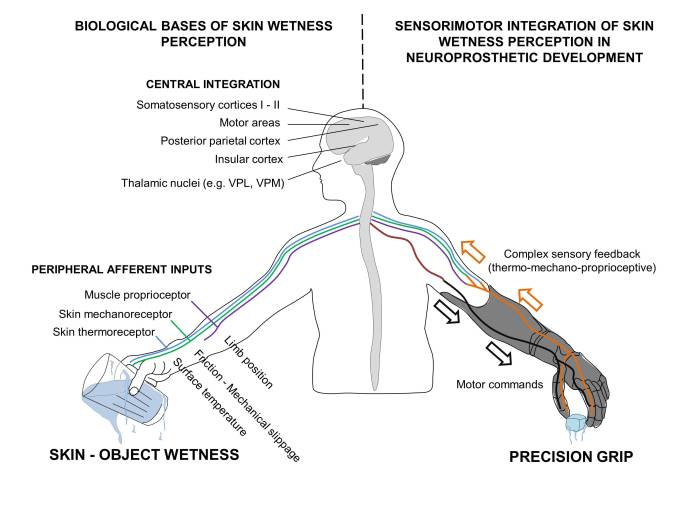
We know that sensing skin wetness is critical in the context of human behavioral and autonomic thermoregulation. However, sensing skin wetness has important implications for object manipulation and manual function. In this recent Journal of Neurophysiology review we explore the biology of wetness sensing, its role in manual function, and the potential for its replication in upper limb neuroprosthetics. 
Enjoy the read!

The biology of skin wetness perception and its implications in manual function and for reproducing complex somatosensory signals in neuroprosthetics

Davide Filingeri, Rochelle Ackerley

Abstract

Our perception of skin wetness is generated readily, yet humans have no known receptor (hygroreceptor) to signal this directly. It is easy to imagine the sensation of water running over our hands, or the feel of rain on our skin. The synthetic sensation of wetness is thought to be produced from a combination of specific skin thermal and tactile inputs, registered through thermoreceptors and mechanoreceptors, respectively. The present review explores how thermal and tactile afference from the periphery can generate the percept of wetness centrally. We propose that the main signals include information about skin cooling, signaled primarily by thinly-myelinated thermoreceptors, and rapid changes in touch, through fast-conducting, myelinated mechanoreceptors. Potential central sites for integration of these signals, and thus the perception of skin wetness, include the primary and secondary somatosensory cortices and the insula cortex. The interactions underlying these processes can also be modeled to aid in understanding and engineering the mechanisms. Further, we discuss the role that sensing wetness could play in precision grip and the dexterous manipulation of objects. We expand on these lines of inquiry to the application of the knowledge in designing and creating skin sensory feedback in prosthetics. The addition of real-time, complex sensory signals would mark a significant advance in the use and incorporation of prosthetic body parts for amputees in everyday life.
figure-1
In the figure: Schematic of peripheral afferent inputs that may contribute to wetness perception.
The left side of the figure shows that thermoreceptive and mechanoreceptive afferents contribute to detecting and perceiving skin wetness. The right side of the figure shows how these signals may be recovered and used in a neuroprosthetic device, signaling both efferent motor commands and complex sensory feedback. The central areas that may generate the perception of wetness include those activated by tactile and thermal inputs (shown), as well as being subject to multisensory influences (e.g. vision) and cognitive processes (e.g. attention, learning).

Tuesday, 10 January 2017

The thermal brain: investigating individual variability in thermoregulatory behaviour in humans

Applications are invited for an exciting PhD program for candidates who are sponsored or have their own funding. 

The project will be based at the Environmental Ergonomics Research Centre, Loughborough University and will be performed under the supervision of Dr Davide Filingeri. 

Feel free to get in touch to discuss sponsorship as well as avenues to secure funding to support this PhD (email: d.filingeri3@lboro.ac.uk).


Project Description

The thermal brain: investigating individual variability in thermoregulatory behaviour in humans

In an attempt to reduce building energy consumption and its impact on climate change, the built environment is focusing more on the design and implementation of personalised comfort systems (systems directly cooling/heating the body of the occupant). However, to be effective, personalized indoor climate standards and applications should accurately represent the thermal demands of all occupants. 

Unfortunately, due to limited research on individual differences in thermoregulatory behaviour and thermal preference of healthy and clinical populations (e.g. individuals with neurological diseases that impair thermal sensitivity), we are still far from reaching “comfort for all”. 

The aim of this PhD will be to investigate individual variability in thermoregulatory behaviour, thermal sensitivity and thermal preference and to characterize its properties based on gender, age, body composition, and presence of neurological conditions. Successful applicants will be using a combination of physiological and psychophysical methods in human-based thermoregulatory research, and will be based at the Environmental Ergonomics Research Centre, which comprises 3 state-of-art climatic chambers. 

Loughborough University is a top-ten rated university in England for research intensity (REF2014) and an outstanding 66% of the work of Loughborough’s academic staff who were eligible to be submitted to the REF was judged as ‘world-leading’ or ‘internationally excellent’, compared to a national average figure of 43%. 

In choosing Loughborough for your research, you’ll work alongside academics who are leaders in their field. You will benefit from comprehensive support and guidance from our Graduate School, including tailored careers advice, to help you succeed in your research and future career. 

Find out more: http://www.lboro.ac.uk/study/postgraduate/supporting-you/research/ 

Entry requirements


Applicants should have, or expect to achieve, at least a 2:1 degree (or equivalent) in Human Biology, Neuroscience, Psychology, Ergonomics or Exercise Science.  A relevant Master’s degree and/or experience in one or more of the following will be an advantage: Human & Applied Physiology, Sensory Neuroscience, Human Factors and Ergonomics, research experience with clinical or non-clinical human participants. 

All applications should be made online at http://www.lboro.ac.uk/study/apply/research/.  Under programme name, select ‘Loughborough Design School’ 

Please quote reference number:  LDS/DF/2017

Funding Notes

This is an open call for candidates who are sponsored or who have their own funding.

Wednesday, 21 December 2016

New personal website

Hi there,

Quick communication to bring to your attention the launch of my new personal website:

https://davidefilingeri.wordpress.com/  

where you will find out more about me, my research and its impact.

The purpose of the webiste is to create a one-stop, first-contact point for everyone interested in research collaborations and enterprise. It includes a News and Contact section.

Feel free to a look around!

DF

Wednesday, 12 October 2016

Fully funded PhD studentship - Somatosensory and thermoregulatory aspects of neurological diseases

Project Description

Applications are invited for a PhD studentship funded by the Graduate School to start in January 2017. The project will be based in the Design School at Loughborough University and will be performed under the supervision of Dr Davide Filingeri. 

PROJECT DETAILS 

The ability to experience skin sensations such as temperature, touch or wetness allows humans to interact effectively with their physical environment. It would be almost impossible to avoid getting dangerously hot on a warm-humid day or to hold and manipulate wet and slippery objects, if we had not evolved sensory systems that translate physical skin stimuli into conscious sensations. The role of skin sensations in normal body function and independent living is even more evident when their underlying neural mechanisms are disrupted. 

Numerous neurological diseases, amongst which Multiple Sclerosis (MS) and Parkinson’s Disease (PD), are accompanied by impairments in skin sensations. MS patients often present reductions in skin temperature sensitivity and this can impair their ability to behaviourally thermoregulate upon exposure to thermal challenges (heat and cold). Decreases in temperature and touch sensitivity are also common in PD patients and these sensory symptoms seem to play a role in the development of well-established motor symptoms (e.g. impairments in precision grip). As most somatosensory symptoms begins during the early development of MS and PD, understanding their physiological and pathological mechanisms is critical for early detection and for the design of assistive devices. 

Using a combination of physiological and psychophysical measurements, this project will explore physiological and pathological aspects of somatosensory dysfunction in neurological diseases (e.g. MS or PD) and their impact on individuals’ ability to interact with their physical environment. 

The studentship is for 3 years and is intended to start in January 2017. The studentship provides a stipend of £14,296.00 plus tuition fees at the UK/EU rate for up to three years. International (non EU) students may apply however the total value of the studentship will be used towards the cost of the International tuition fee. 

Students will normally need to hold, or expect to gain, at least a 2:1 degree (or equivalent) in Human Biology, Neuroscience, Psychology, Ergonomics or Exercise Science. A relevant Master’s degree and/or experience in one or more of the following will be an advantage: Human Physiology, Sensory Neuroscience, Human Factors and Ergonomics, research experience with clinical or non-clinical participants. 

General information about the Design School can be found at: http://www.lboro.ac.uk/departments/design-school/ 

For informal enquiries about the project, please contact Dr Davide Filingeri - email:  

To apply, please complete the online application using the following link http://www.lboro.ac.uk/study/apply/research/ quoting the reference: LDS/DF/10/2016: 

The closing date for applications is November 10th, 2016 
Interviews will take place week commencing November 21st, 2016 

Original advert posted on: https://www.findaphd.com/search/ProjectDetails.aspx?PJID=78027&LID=2922

Wednesday, 27 July 2016

A moment or two with the scientist: video-interview with Vernon Mountcastle

Today I would like to introduce a new initiative of this blog: A moment or two with the scientist. 

Every few weeks, I will be sharing a video-interview of a particular scientist that is of interest to the field of physiology, neuroscience, temperature regulation and somatosensory neurophysiology. These video-interviews are publicly available because of initiatives from the Society of Neuroscience and the American Physiological Society.   

The Society for Neuroscience's autobiography series, "The History of Neuroscience in Autobiography," (https://www.sfn.org/about/history-of-neuroscience/autobiographical-videos-of-prominent-neuroscientists) details the lives and discoveries of eminent senior neuroscientists. The  American Physiological Society's "Living History Project" ( http://www.the-aps.org/mm/Membership/Living-History.aspx) was designed to create an archival video record of senior members of the APS who have made outstanding contributions to the science of physiology, as well as the profession.

Personally, I find these videos useful and inspiring for two main reasons. First, they allow junior scientists like myself to be “exposed” to scientists who I might have only read about and never meet because of either chronological or situational reasons. In my view, “seeing and hearing the mind behind the paper” allows for a more intimate understanding of these scientists’ work. Second, I find that what these interviews contain in terms of memories, recollection and views on science, is particularly inspiring for junior scientists like myself who are at the beginning of their academic careers. Seeing and hearing from the “human being” behind the eminent scientist helps putting things into perspective and understanding that things that are not clear now might make sense further down the line…

So today, the inaugural video of this series see a personal interview with Prof Vernon Mountcastle.

Mountcastle was Professor Emeritus of Neuroscience at Johns Hopkins University and discovered and characterized the columnar organization of the cerebral cortex in the 1950s. His work has been instrumental for the understanding of somatosensory function in primates and humans. Furthermore, his invention of the “combined experiment”, where human psychophysics is performed along with neurophysiological recordings in primates, has been a paradigm shift in the exploration of the function of the nervous system in humans. A must see for all physiologists and neuroscientists and the ones interested in somatosensory neuroscience.

Enjoy!

Davide


Thursday, 14 July 2016

Environmental and Thermal Neurophysiology blog: different name, same spirit

“Nomem est omen”
“The value is in the name”

Roman playwright Plautus in his play Persa

Here we are again, on the EEP blog. After a long silence (the last post dates back to last year!) I have finally decided it was about time to have a fresh start and bring things back to life in a new form and with a new approach. After all, my life is about to change substantially (again!) and it is probably time to get things moving. We say back home in Sicily that “chi si ferma e’ perduto”. Hence, let us keep moving!
Things have changed so much in the past 2 years that it is difficult to find somewhere to start from. Having been post-docching (is that a word?) in Australia first, and now in Berkeley, and having been exposed to different scientists with very different backgrounds, meant it was almost inevitable that my perspective and research interests would change dynamically. And as this blog has always reflected my passions and interests, it was unavoidable that the focus of the blog would change accordingly. So why not starting from the name? After all, as Plautus said, Nomem est omen…I therefore introduce you to the new Environmental and Thermal Neurophysiology blog. As the title of this post says, we have a different name, but we keep the same spirit.

A bit of background
After its foundations in 2012, the now ex-EEP blog grew rapidly and created a modest community of casual and more frequent readers interested in sharing information and research findings in environmental physiology. An average of 500 visits a month was soon the norm. The blog was born soon after the beginning of my PhD at the Environmental Ergonomics Research Center (Loughborough University, UK). Full of enthusiasms for this new adventure, and after an infatuation with outreach in research sparked by many years spent with my long-time mentor and friend Dr Antonino Bianco (see his historical fitnessa360 blog here: http://www.fitnessa360.com/), I decided to get my word out there about the sciency stuff I was interested in. The first post on The XV International Conference on Environmental Ergonomics (ICEE 2013) was out soon after. In the first few months of life of the EEP blog, I even managed to involve some colleagues that at the time agreed to collaborate an article (little note: one of them, Dr Victoria Kendrick, is now my wife J). Now the blog enjoys an average of 3000 visits a month and despite my "low productivity" visits keep going up.

A new start
While the initial enthusiasm for the blog was plenty and pointing upwards, after few years the time available to write posts started to go in the opposite direction. In no time, I indeed found myself juggling to finish a PhD and looking for post-doctoral opportunities. I was lucky enough to get 2 opportunities one after the other (a fellowship at the University of Sydney and post-doc position at UC Berkeley) and things have since moved on. In the meantime my work and interests have evolved and I am now stuck trying to bring together environmental physiology and somatosensory neuroscience into numerous clinical and no-clinical research projects :). Would this work? We shall see…in the meantime, as I think this area of research has the great potential to bring together scientists with multidisciplinary backgrounds, I thought I would re-launch this web-platform to spark some novel interest in the area of Environmental and Thermal Neurophysiology. A number of posts are now ready to go online and hopefully this new start will bring to the blog new readers, new contributors, and new ideas.

Stay tuned.


Davide

Tuesday, 7 July 2015

How do you feel? Lecture by Bud Craig

An inspiring overview of the neuroanatomy of interoception. Insights and implications for sensory integration, chronic pain, thermoregulation and neurological disease.


How do you feel? Lecture by Bud Craig. from Medicinska fakulteten vid LiU on Vimeo.

Wednesday, 28 January 2015

The determinants of thermal comfort in cool water

Hello everyone. My name is Julien Guéritée. I got my Ph.D. a couple of years ago from the University of Portsmouth (UK). The aim of my work was to understand some of the physiological mechanisms driving thermal comfort (and the loss of it!) around water sports. After some time as a post-doc researcher, and, later as a R&D engineer, I founded a consulting firm where I share what I have learned with sports clothing manufacturers.

Davide gave me the opportunity to write a few words about what I have discovered when I was at university. I would like to emphasize that nothing would have been possible without great support from the technical team and the experts in human and applied physiology who work there.

In water, before we started our studies at Portsmouth, research had focused on the safety aspects of cold water (below 15 °C) immersions [1]. Consequently, little was known about thermal comfort in cool water where water sports are undertaken and where maintaining thermal comfort becomes more critical as it affects both the behavioural and pleasure responses [2]. After some extensive literature review, we hypothesized that the hands and feet would be responsible for the loss of overall thermal comfort.

We thus decided to test this hypothesis. However, we could not immerse participants in cold water and expect them to give relevant, accurate and informative answers regarding their thermal comfort state. We all know it, when you jump in cold water, you just feel cold, uncomfortable, and miserable. At that stage, you don’t really care whether your hands or your abdomen is responsible. To avoid this, and get the most of our data, we immersed our participants in a comfortable water temperature of 34.5 °C. After a few minutes, the temperature was decreased to 19.5 °C over 20 min.

During this cooling phase, our resting or exercising volunteers (depending on the day) reported when they no longer felt comfortable and which region was responsible. In practice, they looked at the scale in front of them (going like this: very uncomfortable > uncomfortable > just uncomfortable > just comfortable > comfortable > very comfortable) and they just told me “Julien, I am now ‘just uncomfortable’, and this is because of my arms [they were allowed to give any body region]”.

To be able to explain this subjective event (the loss of overall thermal comfort) with physiological mechanisms, we had to record more “objective” data whilst water (and skin) temperatures were cooling. We know that thermal comfort is equally driven by core and skin temperature [3]. This is why we had decided to continuously collect core and local skin temperatures. By doing so, when participants lost their overall thermal comfort, we had a fairly accurate idea of their thermophysiological status.

First of all, when overall thermal comfort was lost, and in contrast with skin temperatures, core temperature had not changed. Although this was not surprising, it was good to verify it. Secondly, in most cases, when volunteers in swimming briefs became uncomfortable, water (and skin!) temperature was around 30°C.

Surprisingly, the hands and feet were not responsible for the loss of overall thermal comfort. Instead, the chest and the lower back were reported to cause this event. Now this was intriguing and we needed to understand why the extremities were not involved.

You may already know it: our body is not really good at sensing temperature. It is much more sensitive to temperature changes. This is due to the way our thermoreceptors work [see 4 for in-depth description]. When a dynamic thermal stimulus is applied to the skin, the frequency of discharge of the thermoreceptors (the signal our brain eventually receives) is increased and can reach maximum levels depending on the adapting temperature, which can be defined as the steady state discharge frequency observed at constant temperatures (what happens now, as you are reading, if you are thermally comfortable). The faster the rate of change of skin temperature for a given adapting temperature, the greater the dynamic response to cooling up to maximum levels.

The idea was thus to try to explain our findings in the light of our adapting temperatures, the thermal profile of our skin when nothing particular happens (when we are comfortable). We believed that the environmental conditions of a working office on a normal day are those under which many modern humans spend most of their time. The skin temperature distribution across the body in such conditions would therefore be the one the most frequently experienced. In addition, we knew that humans evolved in, and seek, “comfortable” thermoneutral air or microclimate temperatures of 26–28 °C [5].

Therefore, the skin temperature distribution of a resting human, in a thermoneutral environment (a mix of 26-28 °C in minimum clothing and 21 °C with office clothes on) could be the reference upon which subjective thermal responses are based. We thus expected that the influence of each body region on overall thermal comfort would be driven by local adapting temperatures in such environments.

An assessment of the “reference” skin temperature distribution in thermoneutral air indicated that the extremities (hands and feet) were warmer when the loss of overall thermal comfort was reported during immersion than when volunteers were in thermoneutral and comfortable air. We therefore suggested that the regions where temperature remained above the “reference” thermoneutral temperature in air would not determine the onset of overall thermal discomfort, mainly because the stimulation of these regions would not cause a sufficient increase in the frequency of discharge of the cold cutaneous thermoreceptors.

We concluded that in cooling water, or when the skin is more uniform in temperature and cools slowly from a warm stating point, the chest and the lower back rather than the extremities are responsible for the loss of overall thermal comfort. In these situations, hands and feet are already adapted to colder air temperatures while the chest and lower back cool by more than normal.

As I mentioned earlier, this occurred fairly early in the cooling phase of the water. However, we had decided to keep it cooling to be able to observe other responses. Once water temperature had reached 20 °C, it was maintained at that level until the end of the experiments. Only then the influence of the extremities on overall thermal comfort became important. At that point, local skin temperatures of around 21 °C on these regions may have constituted a more “specific” stimulus than that in the warmer temperature of the cooling phase. Hands and feet were colder than what they are “naturally” in air, and sent neurophysiological signals interpreted as very uncomfortable.

This work should have an impact on future research, as it may help understand variations in thermal comfort responses to stimuli across the body. What I report here is only a fraction of what has been investigated. If you want to read more about it, check out the original article “The determinants of thermal comfort in cool water” published in the Scandinavian journal of medicine and science in sports. If you have any questions, please get in touch!

The next topic should deal with the effect of swimming on thermal comfort, and the impact of evaporative cooling on thermal regulation, perception and comfort in air.

Julien Guéritée, PhD


References:

[1]: Golden F, Tipton M. Essentials of sea survival. Champaign, IL, USA: Human Kinetics, 2002: 120–139.

[2]: Chatonnet J, Cabanac M. The perception of thermal comfort. Int J Biometeorol 1965: 9: 183–193.

[3]: Frank MS, Raja SN, Bulcao CF, Goldstein DS. Relative contribution of core and cutaneous temperatures to thermal comfort and autonomic responses in humans. J Appl Physiol 1999: 86: 1588–1593.

[4]: Hensel H. Thermoreception and temperature regulation. London: Academic Press, 1981: 33–49. Monographs of the physiological society; nr. 38.


[5]: Lahr MM, Foley R. Multiple dispersals and modern human origins. Evol Anthropol 1994: 3: 48–60.

Thursday, 22 January 2015

Sensory bases of how humans sense wetness and humidity: an overview of my PhD

It feels ages since my last post on this blog (last august!). However, I have a very good excuse for my lack of posting: I have been busy with the last stage of my PhD… and guess what? Finished! Job done! :) 

Now that I have had the time to cool down, to enjoy a bit of post-VIVA celebrations, it is time to get back to the keyboard.

What I'd like to share with you today is a presentation which is concerned with some of the work I have performed during my PhD.

As you might recall from some of the previous posts, I have been interested in the neurophysiology behind human's ability to sense skin wetness and humidity. Despite a lack of skin humidity receptors ("hygroreceptors"), we are indeed able to sense moisture/sweat on the skin, a fact which I personally find fascinating, to the point that investigating how such sensory process is performed by our brains has become the core of my PhD.

The research work has been quite effective in providing novel insights on how such perception is experienced in humans and you might find some of such findings in my papers:

Paper 2 (thermal & tactile interactions) http://www.ncbi.nlm.nih.gov/pubmed/24269934
Paper 5 (neurophysiological model) http://www.ncbi.nlm.nih.gov/pubmed/24944222
Paper 6 (hygroreceptor across species) http://www.ncbi.nlm.nih.gov/pubmed/25318766

However, should you not fancy digging into some (boring?!) scientific jargon, the media attention that my work has attracted has resulted into some interesting summaries which you can enjoy here:


I was kindly invited by Dr Samuele Marcora (http://goo.gl/N3NihI) to present my work at the University of Kent during one of the School of Sport and Exercise Sciences Research Seminars.

With my presentation I have tried to provide an overview of the concept of skin wetness and of its role in thermal discomfort and behavioural temperature regulation, as well as a summary of some of the results of the experimental work conducted during my PhD.

I hope you'll enjoy it and feel free to get in touch should you have any questions!


Davide Filingeri


Monday, 21 July 2014

Behavioural thermoregulation: notes from a PhD thesis in temperature regulation (work in progress)

Although powerful, the functional capacity of human autonomic thermoregulation is however limited by physiological and biophysical constrains (Schlader et al. 2010). Maximal sweating as well as maximal vasodilation and vasoconstriction is limited by physiological (e.g. sweat gland density and output, number of capillaries) and biological factors (e.g. age) (Martini and Martini 1992; Kenney and Munce 2003). From a biophysical point of view, anthropometrical characteristic also play a role in limiting the functional ability of the autonomic thermoregulatory system. For example, body surface area to mass ratio is an important parameter for heat exchange, which can limit the ability to dissipate heat to the environment. Heat losses are indeed proportional to the gradient between skin and environment and to the surface area available for heat exchange (Havenith 2001b). Thus, given the same body mass, individuals with smaller body surface areas require greater increases in e.g. skin vasodilation and/or sweating than individuals with larger body surface areas in order to dissipate the same amount of heat to the environment, and to prevent core overheating.


Despite these intrinsic physiological limits, humans successfully maintain their thermal balance while being exposed to various extreme environments (e.g. from the moon surface to the Sahara desert), in which autonomic responses alone could not guarantee survival (Romanovsky 2007). In this respect, what assures survival to our specie is the virtually unlimited power of behavioural thermoregulation.


Behavioural thermoregulation can be defined as any conscious decision taken with the aim of maintaining thermal balance and it represents an infinite resource for human body temperature regulation (Schlader et al. 2010; Flouris 2011). Indeed, from simply looking for shade in a sunny and hot day (Parsons 2003), to adding or removing clothing (Havenith 2002), humans constantly adjust their thermal behaviour in order to maintain thermal comfort (Flouris 2011). 

Well, by the look of the fella in the photo we must have learned from our close relatives how to behaviourally thermoregulate :)

Davide Filingeri
PhD Researcher
Environmental Ergonomics Research Centre
Loughborough University, UK


In the picture: A shot from the Jigokudani Monkey Park (Nagano, Japan). The park is famous for its large population of wild Japanese Macaques (Macaca fuscata), more commonly referred to as Snow Monkeys, that go to the valley during the winter, foraging elsewhere in the national park during the warmer months. Starting in 1963, the monkeys descend from the steep cliffs and forest to sit in the warm waters of the onsen (hotsprings), and return to the security of the forests in the evenings (source: Wikipedia).


References
Flouris, A. D. (2011). Functional architecture of behavioural thermoregulation. European journal of applied physiology, 111(1), 1-8. doi:10.1007/s00421-010-1602-8
Havenith, G. (2001). Human surface to mass ratio and body core temperature in exercise heat stress—a concept revisited. Journal of Thermal Biology, 26, 387-393.
Havenith, G. (2002). Interaction of Clothing and Thermoregulation. Exogenous Dermatology, 1(5), 221-230. doi:10.1159/000068802
Kenney, W., & Munce, T. (2003). Invited review: aging and human temperature regulation. Journal of Applied Physiology, (18), 2598-2603.
Martini, F., & Martini, F. (1992). Fundamentals of anatomy and physiology.
Parsons, K. (2003). Human Thermal Environments. London, UK ET - Second: Taylor & Francis.
Romanovsky, A. (2007). Thermoregulation: some concepts have changed. Functional architecture of the thermoregulatory system. American Journal of Physiology- …, 85013, 64-66. doi:10.1152/ajpregu.00668.2006.
Schlader, Z., Stannard, S., & Mündel, T. (2010). Human thermoregulatory behavior during rest and exercise - a prospective review. Physiology & behavior, 99(3), 269-75. doi:10.1016/j.physbeh.2009.12.003